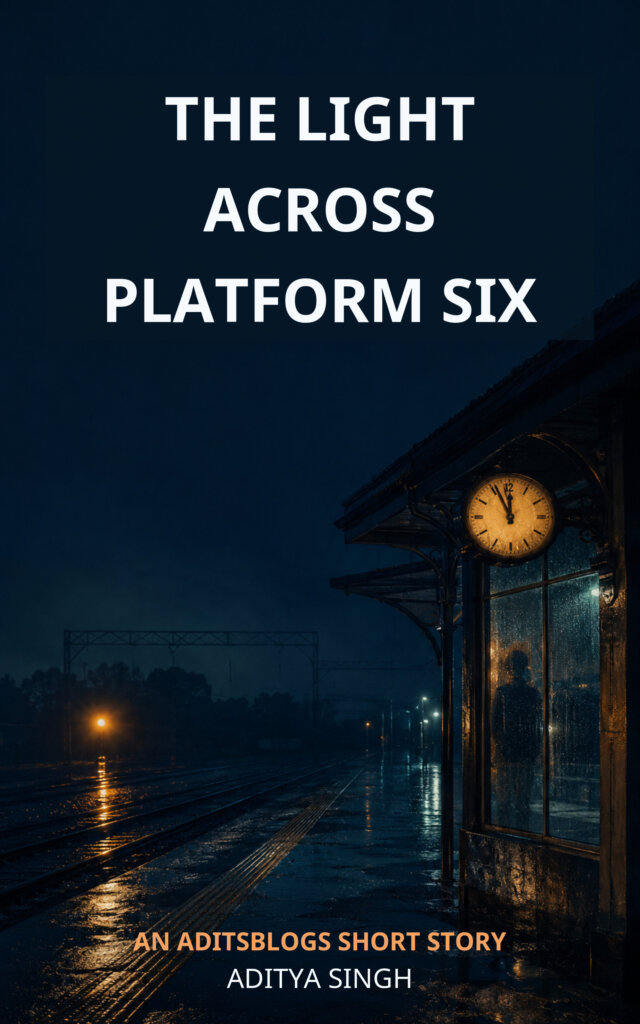
At 11:47 every night, the abandoned lamp across Platform Six switched on.
No train stopped there. No employee admitted that the platform still had electricity. Yet from his booth on Platform Two, station announcer Arin Das watched the yellow light wake inside the fog, burn for exactly three minutes, and disappear.
He had noticed it first on a rain-heavy Monday. By Thursday, it had become a private appointment.
“Old wiring,” said Biplab, the night guard.
“There is no wiring,” Arin replied. “The line was removed after the accident.”
Biplab stopped smiling. Six years earlier, a local passenger train had overshot the signal during a storm. Three coaches derailed beside Platform Six. Seven people died. The platform was closed, then quietly removed from timetables.
Arin remembered the reports because his younger sister Mira had been among the passengers. Her body had never been identified.
The next night, he carried a torch and crossed the footbridge at 11:44.
Platform Six smelled of wet iron and weeds. Moss climbed over the station nameboard. The lamp stood at the far end near an old wooden bench, dark and disconnected.
At 11:47, it came alive.
The light did not flicker. It opened like an eye.
Something lay on the bench: a red notebook, dry despite the rain.
Arin recognised it before touching it. Mira had carried an identical notebook everywhere, filling its pages with sketches of strangers. On the first page, in her rounded handwriting, was a date—the night of the accident.
The early pages were ordinary: commuters asleep against windows, a tea seller counting coins, a child pressing both palms to the glass. Then the drawings changed. Heavy rain. A red signal. A man standing beside the track with one arm raised.
On the final completed page, Mira had drawn the station control room.
Inside it sat Arin.
Below the sketch she had written: “Dada is on the night shift. If the signal fails, he will know what to do.”
Arin’s hands turned cold. He had not been on duty that night. He had swapped shifts to attend a concert and had never told Mira. The substitute operator later said the panel had shown green. The investigation blamed water damage and equipment failure.
A loose page waited after the drawing.
“You weren’t there,” a voice said behind him.
Arin turned. A woman stood beyond the lamp, her outline softened by fog. She wore a blue kurta, the colour Mira had worn in the last photograph taken of her.
“Mira?”
The woman lifted one hand, pointing not at him but toward the end of the platform.
The lamp died.
Arin’s torch beam found a rusted maintenance cabinet hidden by vines. Its lock broke under the first strike of a stone. Inside were old relay logs, a sealed envelope and a small voice recorder.
The recorder still worked.
A man’s nervous voice filled the rain. “Signal Six has been bypassed. The relay keeps dropping to red. Sir said keep the line moving until the minister’s train clears. We cannot report another delay.”
Another voice answered, “Delete the fault entry. The night operator will sign.”
Arin recognised the second speaker: former station superintendent Prabir Sen, now a celebrated railway consultant.
The envelope contained photocopied maintenance complaints and a statement signed by technician Naren Pal. According to the papers, Pal had hidden the evidence after being threatened. He disappeared two days after the crash.
At dawn, Arin handed everything to the railway police.
The story travelled faster than any train. A new inquiry opened. Digital backups confirmed that fault records had been altered. Prabir Sen denied the allegation, but the recorder, signatures and archived messages told a different story.
For the first time in six years, official letters stopped describing the accident as unavoidable.
Arin returned to Platform Six a week later. Workers had cleared the weeds. Investigators photographed the cabinet. The old bench remained.
At 11:47, the lamp did not turn on.
He sat in darkness with Mira’s notebook.
“I’m sorry I wasn’t there,” he said. The words sounded small against the empty tracks. “I thought if I never said it aloud, it would stay a mistake instead of becoming guilt.”
A train passed on the active line, windows blazing through the fog. For a second, every pane became a moving frame. In one of them Arin saw a young woman sketching with her head bent, a red notebook balanced on her knees.
Then the train was gone.
On the notebook’s last blank page, a faint pencil line had appeared.
It formed the outline of a lamp.
Under it were five words in Mira’s handwriting:
“Now switch on your own.”
Arin closed the book.
The next morning, he requested the day shift. He began speaking to the families who had spent six years living beneath the phrase “technical failure.” He helped them organise documents, dates and questions for the inquiry. He could not return the people they had lost, but he could refuse the silence that had buried them.
Months later, Platform Six reopened as a memorial walkway. The old lamp was restored, this time with new wiring and a brass plaque beneath it:
FOR THOSE WHO WAITED FOR THE TRUTH.
Every evening at 11:47, it shone for three minutes.
Arin never again saw the woman in blue. He no longer needed to.
Some lights are not invitations from the dead.
They are instructions for the living.