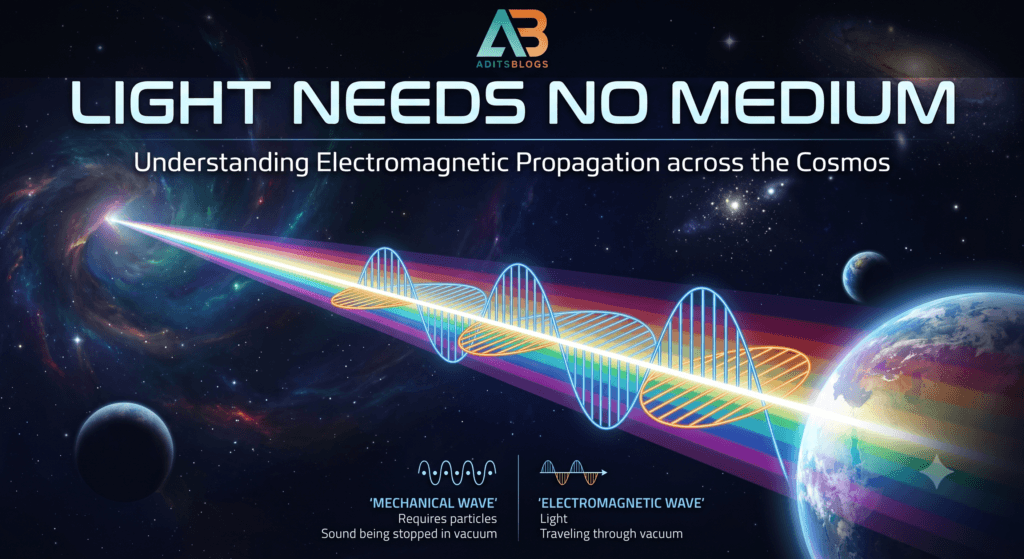
It is one of the most intuitive—yet scientifically incorrect—assumptions we make about physics: if sound requires a physical medium like air or water to travel, light must need one too.
The reality requires flipping that premise entirely. Light never needs a medium to travel, whether it is shooting through the vacuum of deep space or moving through Earth’s atmosphere. While sound is a mechanical wave that relies on bumping atoms together to propagate, light operates on an entirely different set of rules.
Here is exactly how light travels across the universe, why Earth’s mediums actually hinder rather than help it, and the famous experiment that proved space is truly empty.
Mechanical vs. Electromagnetic Waves: Why Light Doesn’t Need a Medium”
To understand why light doesn’t need air, glass, or water to travel, we have to look at what light actually is.
Sound, ocean ripples, and seismic vibrations are mechanical waves. They are forms of energy passing through matter. If there is no matter (like in the vacuum of space), there is nothing for the energy to vibrate, resulting in absolute silence.
Light is an electromagnetic (EM) wave. As famously described by James Clerk Maxwell’s equations in 1865, a changing electric field generates a magnetic field, and a changing magnetic field generates an electric field.
Because these two fields continuously generate one another as they leapfrog forward, the wave is completely self-sustaining. It doesn’t need physical atoms to carry it; the interacting fields are the vehicle.
Read the Original Research: Maxwell’s foundational 1865 paper, “A Dynamical Theory of the Electromagnetic Field,” first proposed that light itself was an electromagnetic disturbance propagating through fields according to electromagnetic laws.
The Cosmic Speed Limit and Earth’s “Traffic Jams”
If light doesn’t need a medium, what is happening when it travels through the air in your room, the water in a pool, or the glass in your windows?
The medium isn’t helping the light travel; it is getting in the way.
In a perfect vacuum, light travels at its absolute speed limit: 299,792 km/s. When light enters a medium like water or glass on Earth, its electromagnetic fields interact with the electromagnetic fields of the atoms in that material. This constant absorption and re-emission of the light by the material’s atoms acts like a microscopic traffic jam, slowing the wave’s overall progression down.
- In a vacuum: 299,792 km/s (100% of maximum speed)
- In air: ~299,700 km/s (Barely slowed)
- In water: ~225,000 km/s (Slowed by ~25%)
- In diamond: ~124,000 km/s (Slowed by ~59%)
The Luminiferous Aether: The Experiment That Changed Physics
The confusion over light needing a medium isn’t just a modern misconception—it was the prevailing scientific consensus for centuries.
Before the 20th century, physicists couldn’t fathom a wave traveling without a physical substance to carry it. Because light travels to us from distant stars, they assumed the entire universe must be filled with an invisible, undetectable medium called the “luminiferous aether.”
In 1887, physicists Albert Michelson and Edward Morley set out to prove the existence of this aether. As the Earth moved through space, they theorized it should create an “aether wind,” much like sticking your hand out the window of a moving car. They built a highly sensitive interferometer to measure changes in the speed of light caused by this wind.
The result? They found absolutely zero change in the speed of light, regardless of which direction the Earth was moving. There was no wind, and there was no aether.
Read the Original Research: The findings were published in the landmark paper, “On the Relative Motion of the Earth and the Luminiferous Ether” (1887).
This “failed” experiment became one of the most important in the history of physics. By proving that the aether didn’t exist, it paved the way for Albert Einstein’s Theory of Special Relativity. It proved once and for all that light stands alone as a wave unbound by physical materials, weaving its own path through the vacuum of space.