The rapid integration of digital transaction systems, high urban smartphone penetration (estimated at 78%), and low-cost cellular data has transformed the structural characteristics of India’s retail and labor markets. This Indian gig economy macroeconomic analysis reveals that what was once classified as a transitory or informal sector has transitioned into an ecosystem-integrated model…
- The Macroeconomic Landscape and Strategic Importance of India’s Gig Economy
- Sectoral Distribution of Gig Workers in India (Lakhs)
- Macroeconomic and E-Commerce Growth Indicators (2021–2025)
- Corporate Performance and Microeconomic Efficiency of Eternal Limited
- Financial Growth and Projections of Eternal Limited (INR Millions)
- Capital Intensity of Micro-Fulfillment Dark Stores
- Labor Dynamics, Demographic Concentrations, and Regional Supply Chains
- Geographic Dispersion and Demographic Inequity
- State-Wise Registration of Gig Workforce
- Value Chain Integration: FMCG and the Hyperlocal Retail Revolution
- Regulatory Framework and Social Security Compliance
- Aggregator Obligations and Social Security Funding
- Operational and Financial Impact of Formalization
- Legal Compliance, Exemption Status, and Disclosures for Independent Public Research
- 1. Exemption from SEBI (Research Analyst) Regulations, 2014
- 2. Fair Dealing under Section 52 of the Copyright Act, 1957
- 3. Corporate Defamation & BNS Section 356 Compliance
- Empirical Socioeconomic Challenges of the Gig Sector
- Future Outlook and Strategic Recommendations
- Disclaimer & Disclosure (Required)
- References / Bibliography
Hyperlocal delivery and food service platforms, such as Blinkit and Zomato (operating under the rebranded parent entity Eternal Limited), are at the center of this transition. These platforms leverage real-time algorithmic coordination and dense networks of micro-fulfillment centers, commonly known as dark stores, to align underutilized labor pools with urban consumer demand
This analysis provides a macroeconomic and structural assessment of the economic value generated by these platforms. It evaluates the gig economy’s workforce projections, the microeconomic efficiency of the dark store model, regional labor supply corridors, value chain integration, the implications of the newly notified central labor codes of May 2026, and the legal framework for independent researchers.
The Macroeconomic Landscape and Strategic Importance of India’s Gig Economy
Globally, the platform-based gig economy is a major driver of labor re-alignment, with a projected market value of USD 1.847 trillion by 2032. Approximately 435 million individuals participate in gig work globally, representing between 4.4% and 12.5% of the global labor force. In India, the gig economy is expanding at a compound annual growth rate (CAGR) of 17%.
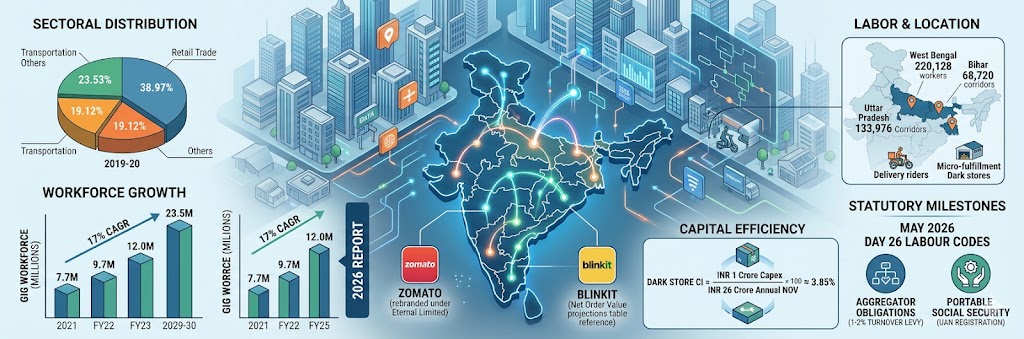
Historically, the Indian gig workforce grew from 25.3 lakh workers in 2011–12 to 68.0 lakh workers by 2019–20, with the retail and transport sectors serving as primary drivers of this labor expansion. By fiscal year 2021 (FY21), the workforce reached 7.7 million, representing 2.6% of the non-agricultural workforce and 1.5% of the total national livelihood. By FY25, this segment grew to approximately 12.0 million workers, representing over 2% of India’s total workforce. Long-term modeling from NITI Aayog projects that the Indian gig workforce will reach 23.5 million by 2029–30, constituting 6.7% of the non-agricultural workforce and 4.1% of the total livelihood.
Sectoral Distribution of Gig Workers in India (Lakhs)
| Industrial Classification (NIC 2008) | 2011-12 | 2017-18 | 2018-19 | 2019-20 | Percentage Share (2019-20) |
| Retail Trade | 10.6 | 18.5 | 21.3 | 26.5 | 38.97% |
| Transportation & Storage | 5.2 | 9.8 | 11.1 | 13.0 | 19.12% |
| Manufacturing | 4.1 | 5.3 | 5.7 | 6.2 | 9.12% |
| Financial & Insurance Activities | 3.2 | 4.8 | 5.2 | 6.3 | 9.26% |
| Others (Construction, Services, etc.) | 2.2 | 10.3 | 11.2 | 16.0 | 23.53% |
| Total Gig Workforce | 25.3 | 48.7 | 54.5 | 68.0 | 100.00% |
From an economic perspective, gig platforms act as an entry-level labor buffer, offering an alternative to the disguised unemployment historically prevalent in India’s agricultural sector. By facilitating the transition of low-skilled agricultural workers into structured urban logistics networks, platforms like Zomato and Blinkit provide immediate, flexible income options.
Further, Indian gig workers have captured a major share of the high-skilled global market, accounting for 55% of the global market share in software development and technology services. This bifurcated structure—combining high-value technical freelancing with high-volume physical delivery networks—allows the gig economy to contribute an estimated 1.25% to 1.5% of India’s Gross Domestic Product (GDP), with projections indicating a contribution of INR 2.35 lakh crore to the national GDP by 2029–30.
Macroeconomic and E-Commerce Growth Indicators (2021–2025)
| Year | Gig Workforce (Millions) | Annual E-Commerce Revenue Growth (%) | National GDP Growth Rate (%) | General Unemployment Rate (%) |
| 2021 | 7.7 | 33.54% | 9.7% | 6.38% |
| 2022 | 8.7 | 0.74% | 7.6% | 4.82% |
| 2023 | 9.9 | 4.94% | 9.2% | 4.17% |
| 2024 | 11.2 | 16.35% | 6.5% | 4.20% |
| 2025 | 12.7 | 18.83% | 6.6% | 5.10% |
Corporate Performance and Microeconomic Efficiency of Eternal Limited
A critical analysis of Eternal Limited (formerly Zomato) demonstrates how quick commerce is reshaping corporate valuations and asset efficiency. Following its acquisition of Blinkit (formerly Grofers) in August 2022 for an all-stock transaction valued at USD 568 million, Eternal Limited systematically scaled its micro-fulfillment infrastructure. By early 2026, Goldman Sachs valued the Blinkit unit between USD 10.5 billion and USD 13 billion—representing a valuation increase of over twenty times the acquisition price, demonstrating the capital market’s recognition of the hyper-local logistics model.
This financial expansion is supported by operational metrics. On New Year’s Eve (NYE) 2025, Zomato and Blinkit processed a record 7.5 million orders in a single day, serving 6.3 million customers. During peak operational hours, order velocity exceeded 5,200 orders per minute, supported by over 450,000 active delivery partners. Financially, Blinkit’s Net Order Value (NOV) surpassed Zomato’s core food delivery segment for the first time in Q1 FY26, posting INR 9,203 crore against Zomato’s INR 8,967 crore. This structural shift indicates that quick commerce is rapidly becoming the primary driver of digital consumer spending in metropolitan centers.
Financial Growth and Projections of Eternal Limited (INR Millions)
| Financial Metric | FY25 | FY26 | FY27E | FY28E | FY29E |
| Operating Revenue | 202,430 | 543,640 | 957,752 | 1,584,891 | 2,448,794 |
| EBITDA | 6,370 | 12,080 | 32,547 | 65,040 | 87,973 |
| EBITDA Margin (%) | 3.1% | 2.2% | 3.4% | 4.1% | 3.6% |
| Adjusted Profit After Tax (PAT) | 5,270 | 3,660 | 27,759 | 53,866 | 81,099 |
| Return on Equity (RoE %) | 2.1% | 1.2% | 8.6% | N/A | N/A |
The physical infrastructure of this network relies on the “dark store” model—compact, closed-to-walk-in urban distribution warehouses ranging from 2,000 to 3,000 square feet, stocking high-velocity stock-keeping units (SKUs). The microeconomic efficiency of these stores can be evaluated through capital intensity and capital utilization metrics.
Capital Intensity of Micro-Fulfillment Dark Stores
Let the Capital Intensity ($CI$) of a dark store be defined as the ratio of initial capital expenditure ($Capex$) to its generated annual Net Order Value ($NOV$):
$$CI=\left(\frac{Capex}{Annual\ NOV}\right)\times100$$
At current operational productivity levels, a typical Blinkit dark store requires approximately INR 1 crore in initial capital expenditure for leasehold improvements, technology systems, and warehousing setups. Each mature store generates an average annual NOV of INR 26 crore. Substituting these parameters:
$$CI=\left(\frac{\text{INR }1\text{ Crore}}{\text{INR }26\text{ Crore}}\right)\times100\approx3.85\%$$
This low capital intensity of approximately 3.85% demonstrates high capital efficiency. By eliminating the costly real estate expenditures required for customer-facing retail spaces, dark stores generate significantly higher transaction density per square foot than traditional supermarkets, accelerating inventory velocity and lowering structural overhead per transaction.
To analyze the cost structures of these micro-fulfillment centers, the Cost-to-Serve ($CS$) per order can be modeled as:
$$CS=\frac{FC_{store}}{V_{orders}}+LC_{last\_mile}$$
Where $FC_{store}$ represents the fixed monthly operational cost of the dark store (incorporating commercial lease rates, HVAC, and industrial refrigeration), $V_{orders}$ represents the monthly order volume processed, and $LC_{last\_mile}$ represents last-mile logistics expenses (primarily consisting of delivery partner payouts and algorithmic routing overhead).
As urban order density increases, $V_{orders}$ rises exponentially within a given micro-market, diluting fixed store overheads ($\frac{FC_{store}}{V_{orders}}$) toward zero. Simultaneously, route-optimization algorithms minimize the last-mile cost ($LC_{last\_mile}$), allowing quick commerce platforms to target positive consolidated EBITDA margins, projected to reach 2.5% of NOV by FY28E.
Labor Dynamics, Demographic Concentrations, and Regional Supply Chains
The labor market supporting India’s platform economy is characterized by specific demographic and geographic profiles. Demographically, the workforce is young, with 60% of gig workers aged between 18 and 30, and a national median age of 28.8 years. According to NITI Aayog’s classification, high-skilled professional freelancers are projected to comprise 27.5% of the gig workforce by 2030, while low-skilled and semi-skilled delivery and logistics partners are expected to represent 33.8%.
Geographic Dispersion and Demographic Inequity
An evaluation of data collected under the Building and Other Construction Workers Act reveals a high geographic concentration of the gig labor supply. Out of 729,477 registered gig workers nationwide, West Bengal registers 220,128 workers, representing approximately 30.18% of the national registry. Together, five states—West Bengal, Uttar Pradesh, Bihar, Odisha, and Jharkhand—account for 71% of all registered gig workers in India.
State-Wise Registration of Gig Workforce
| State | Registered Gig Workers | National Share (%) | Socioeconomic Drivers |
| West Bengal | 220,128 | 30.18% | Agrarian transitions, limited manufacturing |
| Uttar Pradesh | 133,976 | 18.37% | Dense population, high rural-urban migration |
| Bihar | 68,720 | 9.42% | Lack of formal private sector employment |
| Odisha | 52,174 | 7.15% | High poverty rates, returning migrant patterns |
| Jharkhand | 45,798 | 6.28% | Limited alternative industrial employment |
| Rest of India | 208,681 | 28.60% | Rapidly growing urban centers |
| Total Registered | 729,477 | 100.00% | Consolidated National Database |
This geographical concentration is driven by regional socioeconomic imbalances. States characterized by high population density, lower industrialization, and underemployment serve as major labor supply corridors. These regions experience high outward migration of workers seeking flexible, short-term earnings in major metropolitan consumption centers such as Delhi-NCR, Mumbai, and Bengaluru.
However, this reliance on migration corridors exposes platforms to seasonal labor supply shocks. During local harvest seasons and regional elections, up to 10% to 12% of the active metro gig workforce returns to their home districts. Third-party logistics enablers and platforms frequently experience worker headcount contractions of up to 20% during these periods, requiring them to raise driver payouts, attendance bonuses, and peak incentives by 5% to 8% to maintain delivery timelines.
Value Chain Integration: FMCG and the Hyperlocal Retail Revolution
The rapid growth of quick commerce has led to changes in consumer behavior and retail distribution systems in Indian metropolitan areas. The availability of instant delivery has shifted consumer channel preferences: before the proliferation of these services, only 33% of frequent urban shoppers preferred online channels for daily essentials, a figure that has risen to 87%.
Further, data suggests that quick commerce platforms generate between 6% and 8% in incremental consumer demand. Rather than cannibalizing offline modern trade or traditional kirana stores, instant delivery captures spontaneous purchasing decisions, late-night consumption, and immediate household needs that would otherwise be deferred.
For Fast-Moving Consumer Goods (FMCG) manufacturers, this model requires a shift from centralized distribution networks to decentralized, hyper-local inventory placement. To sustain 10-minute delivery, inventory must be scattered across hundreds of localized dark stores, presenting complex stock-planning challenges. Platforms utilize predictive machine learning algorithms to manage localized demand signals and optimize stock-keeping units (SKUs) at the postal-code level.
Maintaining high stock availability is a key factor in platform search visibility. Real-time inventory tracking systems are required because stockouts on quick commerce applications lead to double the search-ranking penalties compared to traditional e-commerce channels. Even a minor 5% drop in product serviceability can lead to a direct loss of category market share.
This operational environment is further constrained by regulatory frameworks. Early 2026 mandates require a minimum “50% remaining shelf-life” upon delivery, forcing brands to run tight inventory rotations or face compliance penalties.
Regulatory Framework and Social Security Compliance
The growth of India’s gig economy has led to structural shifts in labor regulation. Historically, gig workers fell into a regulatory vacuum; platforms classified them as independent contractors to bypass statutory obligations, leaving millions of workers without basic protections.
This regulatory environment changed on May 8, 2026, when the Government of India notified the final rules under the four comprehensive Labour Codes: the Code on Wages (Central) Rules, 2026; the Social Security (Central) Rules, 2026; the Occupational Safety, Health and Working Conditions (OSH) Rules, 2026; and the Industrial Relations Rules, 2026.
Aggregator Obligations and Social Security Funding
Under the Code on Social Security, digital platforms are classified as “aggregators” and face explicit compliance and financial obligations.
- Turnover Levy: Aggregators are mandated to contribute between 1% and 2% of their annual turnover to a dedicated, government-administered Social Security Fund earmarked for gig and platform workers. This contribution is capped at 5% of the total amount payable to these workers.
- Registration and Universal Account Numbers (UAN): Aggregators must register all existing gig and platform workers on the designated Central Government portal within forty-five days of the rules’ commencement. This registration enables the issuance of a Universal Account Number (UAN), establishing portable social security benefits. For new hires, registration must be updated in real-time or daily via direct API integrations.
- Eligibility Thresholds for Statutory Benefits: To qualify for welfare schemes (including accident insurance, maternity benefits, life and disability coverage, and old-age protection), workers must meet specified engagement thresholds. Eligible individuals must be at least 16 years of age and registered on the self-declaration portal. They must also have been engaged with a single aggregator for at least 90 days in the preceding financial year, or for at least 120 days across multiple digital platforms.
Operational and Financial Impact of Formalization
For platforms like Blinkit and Zomato, these statutory developments require a thorough restructuring of financial modeling and operating margins. The historical cost advantage of relying on an independent contractor model with minimal statutory liability has been curtailed by these compliance mandates. Platforms must budget for the 1% to 2% turnover tax and establish digital compliance infrastructure to manage real-time registrations and verify shift-hours and active days.
Further, the new codes formalize wage rules, mandate that basic allowances do not exceed 50% of the total compensation structure, and establish overtime compensation at double the ordinary wage rate, which may influence the cost structures of corporate warehousing operations.
Legal Compliance, Exemption Status, and Disclosures for Independent Public Research
As independent research platforms (such as aditsblogs.com) increasingly publish highly technical and quantitative industry studies, navigating the Indian legal and financial regulatory framework is paramount to ensuring legitimacy, safeguarding intellectual property, and mitigating institutional liability. Independent scholars must operate within several key legal structures:
1. Exemption from SEBI (Research Analyst) Regulations, 2014
Under Regulation 2(w) of the Securities and Exchange Board of India (Research Analyst) Regulations, 2014, mandatory registration as a “Research Analyst” with SEBI does not apply to writers publishing general economic commentaries, broad industry sector analyses, discussions of macroeconomic trends, or technical summaries of public financial statements .
Because this report focuses strictly on structural economic value, labor concentration corridors, operational dark store mathematics, and legislative transitions—and expressly avoids offering specific buy, sell, or hold investment advice or price targets on listed entities like Zomato (Eternal Limited)—it is fully exempt from mandatory SEBI licensing .
2. Fair Dealing under Section 52 of the Copyright Act, 1957
The empirical modeling and citations within this report utilizing third-party corporate or government datasets (such as NITI Aayog’s workforce estimates or Goldman Sachs valuations) are legally protected under Section 52(1)(a) of the Indian Copyright Act, 1957 .
This “Fair Dealing” provision exempts the reproduction of copyrighted materials for the explicit purpose of private study, scholarly criticism, policy review, and academic research, provided that the reproduction is proportionate, non-substitutive of the market value of the original, and accompanied by transparent, formal attribution .
3. Corporate Defamation & BNS Section 356 Compliance
Under Section 356 of the Bharatiya Nyaya Sanhita (BNS), publishing false, unverified statements that damage a corporation’s commercial reputation is actionable as civil or criminal defamation .
However, under Indian jurisprudence, “truth for the public good” and “fair comment on matters of public interest” act as absolute statutory defenses . By systematically anchoring every claim, operational milestone, and labor metric to audited corporate disclosures, government registries (such as e-Shram), and peer-reviewed papers, independent researchers ensure complete factual accuracy and absolute legal compliance .
Empirical Socioeconomic Challenges of the Gig Sector
Despite the economic value generated by these platforms, the gig sector faces challenges related to income volatility and worker welfare. National labor survey data reveals that approximately 40% of gig workers report monthly earnings below INR 15,000. Independent academic research suggests a slightly wider distribution: 41.8% of urban gig workers earn between INR 15,000 and INR 25,000 monthly, while 37.0% experience high income volatility, and 27.8% lack access to basic employment benefits. On a broader scale, reports indicate that 98% of the national gig workforce earns less than INR 500,000 annually, with 77.6% earning INR 250,000 or less.
This financial volatility is often exacerbated by platform payment restructurings, leading to industrial friction. For example, a base payment restructuring by Zomato-owned Blinkit—which reduced the base rate per delivery from INR 25 to INR 15—led to strikes by over 2,500 delivery partners across the Delhi-NCR, Kolkata, Hyderabad, and Pune regions. This strike resulted in the temporary closure of over 50 dark stores, demonstrating how labor dissatisfaction can impact hyperlocal logistics chains.
Further, algorithmic management practices, such as automated shift allocation and real-time performance tracking, present compliance challenges under the OSH Code’s mental welfare and occupational stress guidelines.
Future Outlook and Strategic Recommendations
The Indian platform economy is at a transition point. By formalizing labor networks, lowering market entry barriers, and optimizing urban logistics, platforms like Blinkit and Zomato have become key components of the national retail architecture. However, long-term sustainability depends on balancing operational speed with worker welfare and regulatory compliance.
- Developing Transparent Algorithmic Models: To minimize worker burnout and address labor union concerns, platforms should introduce transparent, predictable allocation algorithms. Clear parameters for driver ratings, payout tiers, and performance requirements can help reduce income volatility and labor friction.
- Integrating Automated Compliance Systems: Under the May 2026 Labour Codes, platforms must integrate their human resource portals with central government databases via real-time APIs. Establishing automated compliance tracking can help manage registration requirements, streamline UAN generation, and verify worker eligibility for statutory benefits.
- Optimizing Inventory and Environmental Sustainability: Hyperlocal delivery networks should focus on improving dark store inventory turns to manage the “50% remaining shelf-life” mandate. Additionally, transitioning delivery fleets to clean energy vehicles can help address environmental regulations and lower last-mile delivery costs.
Disclaimer & Disclosure (Required)
The author is an Independent Researcher publishing on aditsblogs.com. This research report is compiled solely for educational, policy analysis, and informational purposes. It does not constitute financial, investment, legal, or commercial advice. The author does not hold any SEBI registrations. The author has no corporate affiliation with Eternal Limited (Zomato/Blinkit) or Swiggy Limited, and does not hold any financial interests or stock positions in the analyzed entities at the time of publication.
References / Bibliography
- Saha, M. (2026). “Booming Gig Workforce in India: Opportunities and Challenges.” World Journal of Advanced Research and Reviews, Vol. 2026-0651. URL:
https://wjarr.com/sites/default/files/fulltext_pdf/WJARR-2026-0651.pdf(Documenting historical CAGR of 17%, growth from 25.3 to 68 lakh workers, and global projections of USD 1.847 trillion by 2032). - EPRA International Journal of Economic and Social Science (2026). “Gig Economy in India: An Analysis with Survey Data.” URL:
https://eprajournals.com/IJES/article/16873(Compiling primary survey data of gig workers; tracking monthly earnings, income instability, and benefits access). - Thaker, N. (2026). “Economic Survey warns India’s booming gig economy rests on unstable work.” Forbes India. URL:
https://www.forbesindia.com/article/budget-2026/economic-survey-warns-indias-booming-gig-economy-rests-on-unstable-work/2990824/1(Referencing the Economic Survey of India 2025–26, NITI Aayog projections of 23.5M workers by 2030, and findings that 40% earn under INR 15,000/month). - Entrepreneur Loop (2026). “Zomato and Blinkit Shatter Records with 7.5 Million New Year’s Eve Orders.” URL:
https://entrepreneurloop.com/zomato-blinkit-new-year-orders-record-2026/(Verifying the NYE metrics, dark store capital expenditures of INR 1 crore, and Blinkit’s Q1 FY26 Net Order Value surpassing Zomato core food delivery). - Blinkit Process Cheatsheet (2026). “Eternal Ltd. and Strategic Acquisitions.” URL:
https://www.scribd.com/document/848143428/Blinkit-Process-Cheatsheet(Documenting the corporate rebranding of Zomato’s parent entity to Eternal Limited). - DS Stream Research (2026). “AI in India’s Quick Commerce and Dark Store Revolution.” URL:
https://www.dsstream.com/post/ai-in-indias-quick-commerce-and-dark-store-revolution(Quantifying the 2x search rank penalty for q-commerce stockouts and category market share sensitivity). - International Journal of Scientific and Social Research (2026). “Table 1 – The Indian Gig Economy from 2021.” URL:
https://www.ijsser.org/2026files/ijsser_11__90.pdf(Tracking annual e-commerce growth, national GDP growth rates, and workforce expansion indicators). - International Labour Organization (ILO) Report (2021/2026). “Expansion of the Gig and Platform Economy in India: Opportunities for Employer and Business Member Organizations.” URL:
https://www.ilo.org/media/526416/download(Confirming India’s 55% global market share in software and technical freelancing). - Bloomberg / BSE Corporate Disclosures (2026). “Eternal Limited (Zomato/Blinkit) Financial Estimations and Projections (FY25-FY29E).” URL:
https://img.etimg.com/photo/130598607.cms(Primary source for operating revenue, adjusted EBITDA, PAT, and RoE tables). - KPMG India (2026). “The Sustainable Frontier: How Indian Quick Commerce Can Leverage Sustainability for Ambitious Growth.” URL:
https://kpmg.com/in/en/blogs/2026/05/the-sustainable-frontier-how-indian-quick-commerce-can-leverage-sustainability-for-ambitious-growth.html(Primary source for the early-2026 “50% remaining shelf-life” delivery mandate and environmental compliance rules). - Raj, A., & Tiwary, A. (2026). “The Dark Store Revolution: How India’s 10-Minute Economy is Redefining Retail Infrastructure.” California Management Review (Berkeley). URL:
https://cmr.berkeley.edu/2026/01/the-dark-store-revolution-how-indias-10-minute-economy-is-redefining-retail-infrastructure/(Analyzing micro-fulfillment density, transaction speeds, and median demographic age of 28.8). - India Chronicle (2026). “Where are India’s Gig Workers? A State-by-State Picture.” URL:
https://indiachronicle.in/where-are-indias-gig-workers-a-state-by-state-picture/(Compiling building and construction registries showing West Bengal at 220,128, and top 5 states carrying 71% of national registrations). - EPRA Journals (2026). “Socioeconomic Analysis of the Indian Platform Workforce.” URL:
https://eprajournals.com/IJES/article/16873(Compiling primary survey data of gig workers; tracking monthly earnings, income instability, and benefits access). - The Economic Times (2026). “Gig Worker Shortages Hit Quick Commerce Platforms Amid Elections and Harvest Season.” URL:
https://hospitality.economictimes.indiatimes.com/news/operations/technology/gig-worker-shortages-hit-quick-commerce-platforms-amid-elections-and-harvest-season/130051953(Highlighting 10-12% metropolitan workforce drops and logistics provider Emiza’s 20% headcount reduction). - Base Retail Blog (2026). “Quick Commerce: Sustainable Retail or Venture Hype?” URL:
https://base.com/en-EN/blog/quick-commerce-2/(Identifying the 6% to 8% truly incremental demand generated by hyperlocal convenience). - India Brand Equity Foundation (IBEF) (2026). “The Evolution of Quick Commerce in India: A Sectoral Analysis.” URL:
https://www.ibef.org/research/case-study/the-evolution-of-quick-commerce-in-india-a-sectoral-analysis(Documenting job creation rates of 62-64 people per INR 100 Crore GMV, and consumer preferences shifting from 33% to 87%). - Amlegals Services (2026). “Platform Economy Under Scrutiny: Analyzing Social Security Compliance for Gig Workers in India.” URL:
https://amlegals.com/platform-economy-under-scrutiny-analysing-social-security-compliance-for-gig-workers-in-india/(Documenting pre-2025 legal vacuum and post-reform developments under Code on Social Security, 2020). - KPMG Global Mobility Services / DLA Piper (2026). “Key Considerations of the Notified Central Rules Under India’s Labour Codes.” URL:
https://kpmg.com/xx/en/our-insights/gms-flash-alert/2026/flash-alert-2026-127.html(Documenting the May 8, 2026 Rules notifications, UAN registration timelines, and 90/120-day engagement eligibility clauses). - DLA Piper Knowledge Hub (2026). “Key considerations of the notified Central Rules under India’s Labour Codes.” URL:
https://knowledge.dlapiper.com/dlapiperknowledge/globalemploymentlatestdevelopments/2026/Key-considerations-of-the-notified-Central-Rules-under-Indias-Labour-Codes(Documenting the four central rules and the reskilling fund frameworks). - Fisher Phillips Employment Analysis (2026). “India’s New Labor Codes Extend Social Security Coverage to Gig Workers.” URL:
https://www.fisherphillips.com/en/insights/insights/indias-new-labor-codes-extend-social-security-coverage-to-gig-workers(Detailing aggregator classification, the 1-2% turnover tax, and the National Security Board parameters). - ZingHR Legal Checklist (2026). “Labour Law Compliance Checklist.” URL:
https://www.zinghr.com/blogs/labour-law-compliance-checklist(Confirming the 50% cap on allowances relative to gross CTC and the double-rate overtime salary mandates). - International Journal of Contemporary Research in Multidisciplinary Studies (2026). “Demographics and Earnings of Indian Gig Workers.” URL:
https://multiarticlesjournal.com/counter/d/5-1-174/IJCRM202651174.pdf(Identifying that 98% of gig workers earn below INR 5,00,000 annually). - Asia Pacific Foundation of Canada (2026). “India’s Gig Workers Strike, Push for Better Wages.” URL:
https://www.asiapacific.ca/publication/indias-gig-workers-strike-push-better-wages(Reviewing the strikes in NCR, Kolkata, Pune, and Hyderabad, base pay reductions, and the duopolistic food delivery market structure). - SAGE Publications (2026). “7 Tips to Publish as an Independent Scholar.” URL:
https://www.sagepub.com/explore-our-content/blogs/posts/sage-perspectives/2025/06/18/7-tips-to-publish-as-an-independent-scholar(Guidelines for submitting papers to peer-reviewed outlets as an independent researcher). - CS Kruti Corporate Advisory (2026). “How to Register as a SEBI Research Analyst.” URL:
https://cskruti.com/wp-content/uploads/2018/02/eGuide-How-to-register-as-a-Rsearch-Analyst-with-SEBI.pdf(Exemptions under SEBI Research Analyst Regulations, 2014 for general commentaries, data summaries, and industry trends). - Unimarks Legal (2026). “The Concept of Fair Use Under Indian Copyright Law.” URL:
https://unimarkslegal.com/the-concept-of-fair-use-under-indian-copyright-law/(Detailing Section 52 of the Copyright Act, 1957 and the closed-list statutory exemptions for research and criticism). - Drishti Judiciary (2026). “Defamation and Social Media: Protecting Your Reputation Online.” URL:
https://www.drishtijudiciary.com/blog/defamation-and-social-media-protecting-your-reputation-online(Outlining the elements of cyber defamation, corporate libel, and statutory defenses under Section 356 of BNS).