

Why New Year Resolutions Fail?
- Table of Contents
- Why Do New Year Resolutions Fail? The Psychology Behind the Collapse
- 1. Your Brain is Wired for Autopilot, Not Change
- 2. Your Goals Are Too Vague
- 3. You’re Setting Outcome Goals Instead of Process Goals
- 4. Perfectionism and the “All-or-Nothing” Trap
- 5. Motivation is Unreliable (And You Can’t Rely on Willpower Alone)
- 6. You Didn’t Consider Your “Why”
- The Missing Element: Identity Over Behavior
- How to Make New Year Resolutions That Actually Stick: The Science-Backed Framework
- Step 1: Start Impossibly Small
- Step 2: Use the SMART Framework to Eliminate Vagueness
- Step 3: Master the Habit Loop—Cue, Routine, Reward
- Step 4: Design Your Environment to Win
- Step 5: Build an Accountability System
- Step 6: Track, Celebrate, and Forgive
- The Role of Micro-Habits and the 66-Day Myth
- Why Accountability Matters (Even If It Feels Awkward)
- Final Takeaway: You’re Not Broken—The System Was
- 📧 Get New Posts by Email
It’s January 1st. You’re full of hope and energy. This year will be different, you tell yourself. You’ll finally hit the gym five days a week. You’ll save $5,000. You’ll learn that language. You’ll quit sugar.
By January 15th, it’s getting harder.
SEMrush – SEO & marketing toolkit
All‑in‑one platform for keyword ideas, competitor research, basic site audits, and simple tracking of your search visibility.
Amazon – creator & work gear
Browse laptops, microphones, lighting, and other basic tools that can support blogging, recording, or work‑from‑home setups.
Some links above are affiliate links. If you choose to purchase through them, it can support this site at no extra cost to you.
By February 1st, you’ve quit.
You’re not alone—in fact, you’re in the massive majority. Research shows that 80-92% of people who set New Year’s resolutions abandon them by mid-February, with roughly only 8% actually achieving their goals. There’s even a term for the peak quitter moment: “Quitter’s Day“—the second Friday of January, when resolution abandonment hits its highest point.
But here’s the thing: you’re not lazy, undisciplined, or weak. The system of how we set resolutions is fundamentally broken. And the good news? Understanding why resolutions fail is the first step to actually making one that sticks.
Table of Contents
Why Do New Year Resolutions Fail? The Psychology Behind the Collapse

To understand why goals crumble so easily, we need to look at how your brain actually works—not how you wish it worked.
1. Your Brain is Wired for Autopilot, Not Change
Your brain is an efficiency machine. It conserves energy by turning repeated actions into habits—things you can do without thinking. Driving to work, brushing your teeth, scrolling your phone—these are automatic because they’re stored in your brain’s basal ganglia, the habit center.
When you set a resolution to do something different—hit the gym, eat healthier, meditate—you’re asking your prefrontal cortex (your brain’s decision-making center) to take over. This requires significantly more mental energy than autopilot mode, which is why new behaviors feel exhausting after just a few days.
2. Your Goals Are Too Vague
“Exercise more.” “Eat healthier.” “Save money.” Sound familiar?
These resolutions lack specificity, which means they lack measurability, which means they lack accountability. Without a clear target, it’s impossible to know if you’re succeeding or failing. Worse, when motivation fades—and it will—there’s nothing concrete keeping you anchored.
The consequence? You miss one workout and tell yourself, “Well, I’ve already failed,” which leads to the “all-or-nothing” mentality that kills most resolutions by February.
3. You’re Setting Outcome Goals Instead of Process Goals
Here’s a subtle but critical mistake: setting goals based on results (lose 20 pounds) instead of actions (walk 30 minutes five days a week).
Outcome goals are dependent on perfect consistency and external factors. One bad week, one illness, one family emergency—and suddenly the goal feels unachievable. Process goals, on the other hand, shift focus to the behaviors you control daily. They’re inherently more forgiving and realistic.
4. Perfectionism and the “All-or-Nothing” Trap
Perfectionism is resolution’s silent killer. If you set a goal to hit the gym five days a week and miss one day, you mentally label it as failure. This triggers the “abstinence violation effect”—a psychological phenomenon where one slip-up feels like total failure, leading to complete abandonment of the goal.
5. Motivation is Unreliable (And You Can’t Rely on Willpower Alone)
January motivation is high because it’s a fresh start. But motivation is like the weather—it changes. By February, the initial excitement fades, and you’re left relying on willpower. Problem: willpower is a limited mental resource. Research shows that decision fatigue and the depletion of mental energy throughout the day make sticking to new behaviors exponentially harder as January progresses.
6. You Didn’t Consider Your “Why”
Many resolutions are set because of external pressure—what your friends are doing, what society expects, what you think you should want. These externally-driven goals lack emotional resonance. Without a deep “why” connected to your identity and values, there’s no emotional anchor to pull you back when things get tough.
The Missing Element: Identity Over Behavior
Here’s what most resolution frameworks miss: lasting change comes from identity shift, not just behavior modification.
Instead of thinking “I want to exercise more,” ask yourself: Who am I becoming? If you shift from “I want to lose weight” to “I’m someone who prioritizes their health,” the actions that follow feel like expressions of identity, not punishments. This identity-based approach, rooted in behavioral psychology, creates lasting habits because the behavior becomes part of how you see yourself.
How to Make New Year Resolutions That Actually Stick: The Science-Backed Framework
The good news? Decades of behavioral research have identified exactly what works. Here’s how to set resolutions that survive beyond February.
Step 1: Start Impossibly Small
Forget aiming for 5 gym sessions a week. Start with one 15-minute walk after lunch, once a week.
Small wins trigger dopamine—the brain’s “feel-good” chemical—which reinforces the behavior loop. Small, repeated successes build momentum and prove to your brain that you’re someone who follows through. After building consistency with one behavior, you can add more.
Try this: Choose a micro-goal so small you almost can’t fail. The goal isn’t intensity; it’s consistency.
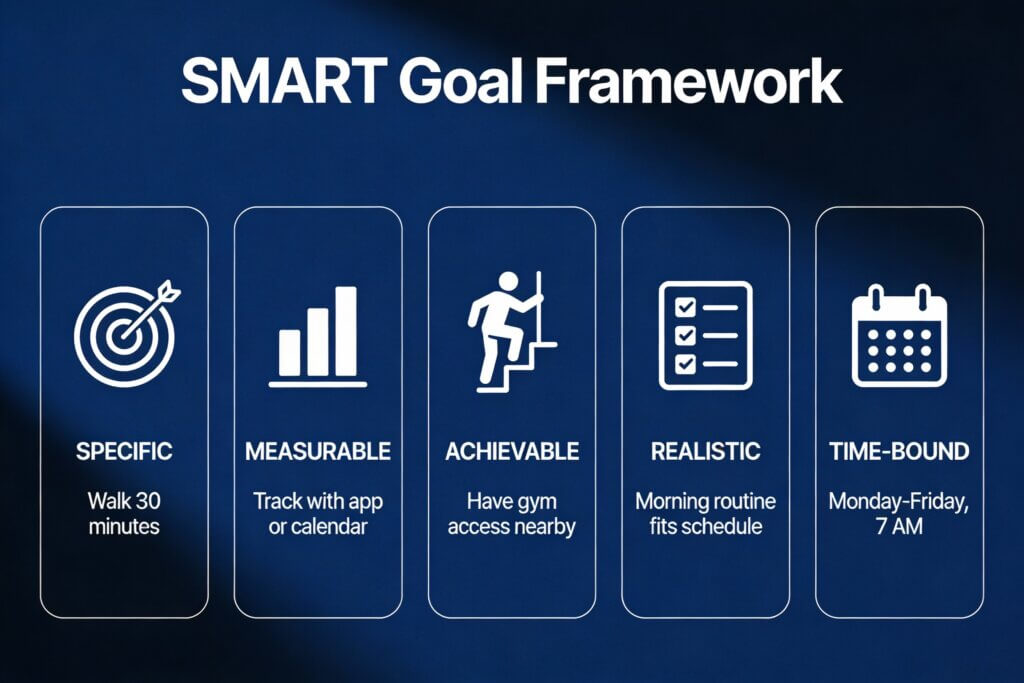
Step 2: Use the SMART Framework to Eliminate Vagueness
Transform vague resolutions into crystal-clear goals:
- Specific: What exactly are you doing? (not “exercise more” but “walk for 20 minutes”)
- Measurable: How will you track it? (use a habit-tracking app, a calendar, or a simple checklist)
- Achievable: Do you have the resources needed? (do you need a gym membership, a yoga mat, an app subscription?)
- Realistic: Is this realistic given your time and circumstances? (can you realistically do this given your job, family, and budget?)
- Time-bound: When specifically will you do this? (Monday-Friday, 7 AM before work; Saturday mornings at 9 AM)
Example: “I will walk for 30 minutes before work, Monday through Friday, for eight weeks. I’ll use my phone’s step counter to track progress.”
Instead of: “Exercise more.”
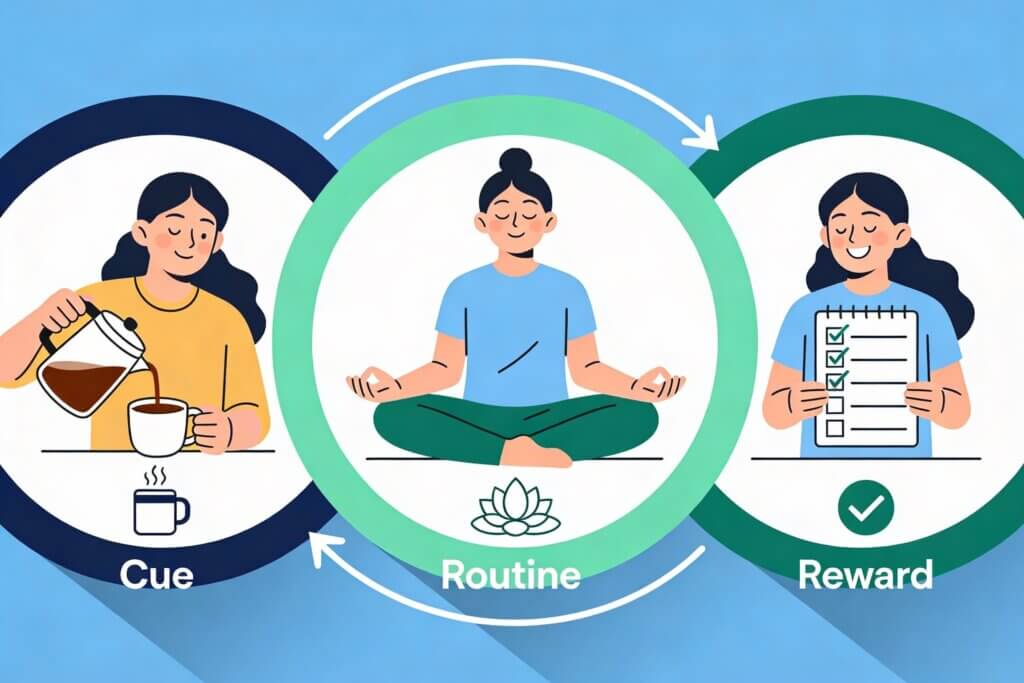
Step 3: Master the Habit Loop—Cue, Routine, Reward
Every habit has three components:
- Cue (Trigger): A specific time, place, or preceding action that signals the habit. (“After I pour my morning coffee…”)
- Routine (Action): The behavior itself. (“I’ll do 5 minutes of stretching”)
- Reward (Payoff): The immediate gratification that reinforces the loop. (“I’ll do 2 minutes of my favorite song” or “I’ll check it off my tracker”)
By intentionally designing all three, you remove decision-making from the equation. The habit becomes automatic faster.
Pro tip: Use habit stacking—attach a new behavior to an established routine. Want to meditate? Do it right after your morning coffee. Want to read? Do it immediately after lunch. This leverages existing habits as cues for new ones.
Step 4: Design Your Environment to Win
Your environment is more powerful than willpower. If your goal is to eat healthier, put fruits and vegetables at eye level in your fridge. If you want to exercise in the morning, lay out your gym clothes the night before. If you want to read more, keep your book on your nightstand.
Remove friction from desired behaviors and add friction to undesired ones.
Step 5: Build an Accountability System
Here’s where accountability tools come into play. Many people try to achieve goals solo, which significantly reduces success rates. Instead:
- Share your goal with someone who will check in on you weekly
- Join a group with others pursuing similar goals
- Use a habit-tracking app that sends reminders and celebrates milestones
- Consider accountability software that monitors your progress
Tools to consider:
- Try Moosend for free — Set up automated accountability email reminders for your resolutions. Moosend’s email automation makes it easy to stay on track with weekly progress check-ins.
- Get started with SentryPC — Monitor your time and habits to increase accountability for digital goals and productivity targets.
- Create a goal dashboard with Elementor — Design a personal website or dashboard to track and visualize your resolution progress publicly.
Step 6: Track, Celebrate, and Forgive
The habit loop isn’t complete without the reward. Every time you complete your micro-habit, celebrate it—check it off, use a habit-tracking app, or give yourself a small reward. This reinforcement strengthens the neural pathway associated with the behavior.
Equally important: When you inevitably miss a day, forgive yourself. Research shows that self-compassion—not self-criticism—is what keeps people consistent long-term. One missed workout doesn’t mean the resolution is over. It means you missed one day. The habit continues tomorrow.
The Role of Micro-Habits and the 66-Day Myth
You’ve probably heard it takes 21 days to form a habit. Actually, research shows it takes an average of 66 days—and varies significantly based on the complexity of the habit and your individual circumstances. Stop expecting overnight transformation. Instead, commit to 8-12 weeks of consistency, knowing that by week 8 or 9, the behavior will feel more automatic.
Why Accountability Matters (Even If It Feels Awkward)
Research from the Diabetes Prevention Program and other large behavioral studies consistently shows that group support and external accountability dramatically increase goal achievement rates. People learn from each other, reinforce each other’s progress, and are less likely to quit when someone else is counting on them.
Consider these options:
- Join a Fiverr accountability coach — Hire a goal-setting or accountability coach for affordable weekly check-ins.
- Explore Gumroad for digital courses — Find expert-led courses on habit formation, goal-setting, and behavioral change to deepen your understanding.
Final Takeaway: You’re Not Broken—The System Was
Here’s the truth: You don’t lack discipline. You lack a system that works with your brain, not against it.
The 80% failure rate isn’t a reflection of your willpower or worth. It’s a reflection of the flawed approach most people take to resolutions. Set vague goals, rely on motivation and willpower, aim too high too fast, go solo, and expect overnight change—and of course you’ll fail.
But now you know better. Use the SMART framework. Start small. Design your environment. Build accountability. Use the habit loop. Give yourself grace.
This year can be different. Not because you’re magically more disciplined than before, but because you’re using a system that actually works.
Your January 15th self will thank you.

About Aditya Singh
I write content on Blogging, Digital Marketing, Tech, and Life- skills. I also write Poetry and Short-Stories in my free time.
Related products on Amazon
Suggestions loosely based on this article
Affiliate note: Some links below are affiliate links. If you choose to buy through them, it can support this site at no extra cost to you.


Product details and prices are taken from Amazon pages and can change over time.