Disclosure: this post may contain affiliate links; AditsBlogs may earn a commission at no extra cost to you.
- Understanding Home Equity Mechanics
- What Is a Cash-Out Refinance?
- How It Works (Worked Example):
- Pros of Cash-Out Refinances:
- Cons of Cash-Out Refinances:
- What Is a HELOC (Home Equity Line of Credit)?
- The Two Phases of a HELOC:
- Pros of a HELOC:
- Cons of a HELOC:
- Side-by-Side Feature Comparison
- Underwriting Criteria & Qualification Checklist
- Decision Matrix: Which Option Should You Choose?
- Choose a Cash-Out Refinance if:
- Choose a HELOC if:
- Frequently Asked Questions (FAQs)
- 1. Is a HELOC better than a Cash-Out Refinance in 2026?
- 2. What is the maximum LTV allowed for a Cash-Out Refinance vs. a HELOC?
- 3. Will refinancing or taking a HELOC hurt my credit score?
For homeowners looking to leverage built-up equity, choosing between a Cash-Out Refinance and a Home Equity Line of Credit (HELOC) is one of the most critical financial decisions you will make. With changing interest rate benchmarks and evolving underwriting standards in 2026, the right choice depends heavily on your existing mortgage rate, how much capital you need, and your repayment timeline.
This comprehensive guide breaks down the core mechanics, interest rate impacts, fee structures, and underwriting criteria for both options to help you determine which loan product saves you the most money.
Understanding Home Equity Mechanics
Home equity is the difference between your property’s current fair market value and your outstanding mortgage balance.
$$\text{Home Equity} = \text{Appraised Home Value} – \text{Current Loan Balance}$$
As property values rise and you pay down principal each month, your equity grows. Both Cash-Out Refinancing and HELOCs allow you to convert this illiquid equity into usable capital, but they structure the debt in fundamentally different ways.
What Is a Cash-Out Refinance?
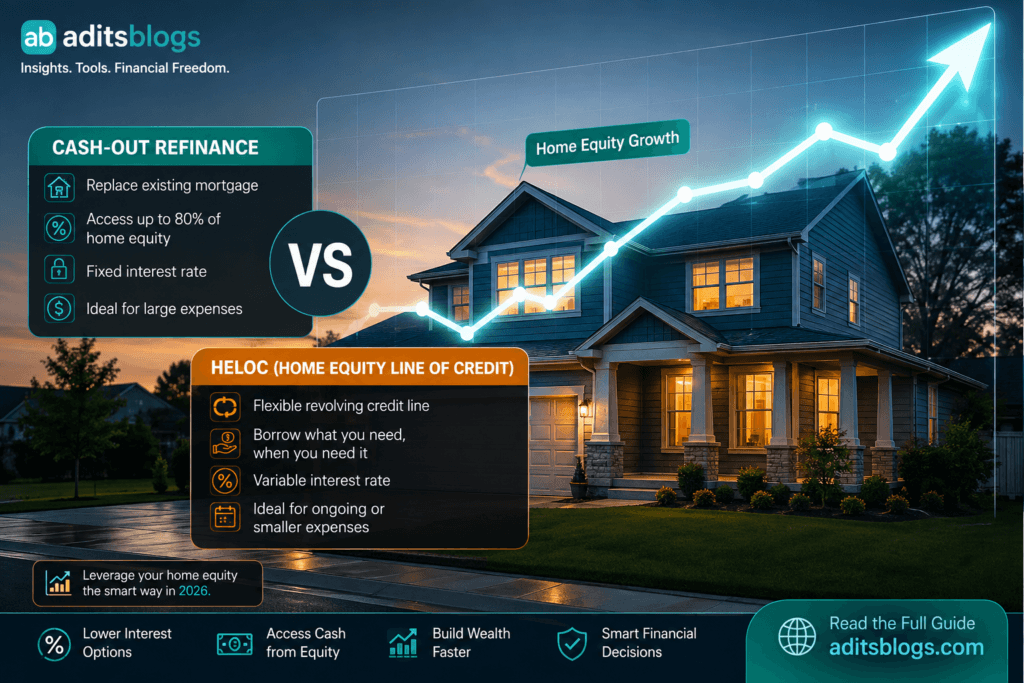
A Cash-Out Refinance replaces your existing primary mortgage with a completely new, larger first mortgage. Your new loan pays off your existing mortgage balance, covers closing costs, and provides the remaining difference in a lump sum payout at closing.
+-------------------------------------------------------+
|                NEW FIRST MORTGAGE                     |
|  (Pays off existing mortgage + Cash paid out to you)  |
+-------------------------------------------------------+
How It Works (Worked Example):
- Appraised Property Value: $400,000
- Existing Mortgage Balance: $200,000 (at 4.0% interest)
- Maximum Loan-to-Value (80% LTV): $320,000
- New Loan Amount: $280,000
- Result: You receive $80,000 in cash (minus closing fees), and your original 4.0% interest rate is replaced entirely by the prevailing market rate on the new $280,000 principal.
Pros of Cash-Out Refinances:
- Fixed Monthly Payment: Most cash-out mortgages use fixed interest rates, protecting you from future market spikes.
- Single Monthly Debt Payment: Keeps your debt streamlined under one mortgage statement.
- Potentially Lower Rates than Unsecured Credit: Interest rates are significantly lower than personal loans or credit cards.
Cons of Cash-Out Refinances:
- Replaces Your Current First Mortgage: If your original mortgage has a low fixed rate (e.g., 3.0%–4.0%), refinancing your entire balance into a higher market rate will significantly increase your monthly interest expense.
- Higher Closing Costs: Closing fees range from 2% to 5% of the total new loan amount.
What Is a HELOC (Home Equity Line of Credit)?
A HELOC is a revolving second mortgage that functions similarly to a credit card, secured by your home. It sits behind your primary mortgage without altering its original interest rate or terms.
+-------------------------------------------------------+
|  FIRST MORTGAGE (Untouched original loan & rate)      |
+-------------------------------------------------------+
|  HELOC SECOND MORTGAGE (Revolving credit line)        |
+-------------------------------------------------------+
The Two Phases of a HELOC:
- The Draw Period (typically 5–10 years): You borrow against your credit limit as needed and usually make interest-only payments on the amount drawn.
- The Repayment Period (typically 10–20 years): The credit line closes. You can no longer borrow funds, and you make fully amortized principal + interest payments on the remaining balance.
Pros of a HELOC:
- Preserves Your Existing First Mortgage: Your primary mortgage rate remains completely untouched.
- Flexible Borrowing: Borrow only what you need, when you need it, paying interest strictly on the drawn amount.
- Lower Upfront Closing Costs: Many lenders offer low-cost or zero-closing-cost HELOC promotions.
Cons of a HELOC:
- Variable Interest Rates: HELOC interest rates are typically tied to the Prime Rate, making monthly payments subject to rate fluctuations.
- Payment Shock: Once the draw period ends, monthly payments increase significantly as principal repayment begins.
Side-by-Side Feature Comparison
| Feature | Cash-Out Refinance | HELOC (Home Equity Line of Credit) |
| Lien Position | First Mortgage | Second Mortgage |
| Payout Structure | Lump-Sum Distribution | Revolving Credit Line |
| Interest Rate Type | Fixed Rate (usually) | Variable Rate (usually) |
| Impact on Original Rate | Replaces original rate entirely | Keeps original rate untouched |
| Closing Costs | 2% – 5% of total loan amount | Minimal to $0 |
| Maximum Combined LTV | 80% | 80% – 85% |
| Best For | Large, one-time expenses | Ongoing or phased costs |
Underwriting Criteria & Qualification Checklist
When applying for either loan product, lenders evaluate key financial metrics during underwriting:
- Credit Score Requirements:
- Cash-Out Refinance: Minimum 620 FICO (740+ for premium rates).
- HELOC: Minimum 680 FICO (720+ preferred by most institutional lenders).
- Debt-to-Income (DTI) Ratio:
- Lenders require your total monthly debt payments (including the new home equity obligation) to stay below 43%–50% of your gross monthly income.
- Combined Loan-to-Value (CLTV) Limits:
- Total debt against the property cannot exceed 80% to 85% of the appraised home value.
For detailed industry guidelines on consumer debt disclosures and credit protections, review resources from the Consumer Financial Protection Bureau (CFPB) and macroeconomic indicators on FRED. You can also browse further mortgage breakdowns on AditsBlogs.
Decision Matrix: Which Option Should You Choose?
Choose a Cash-Out Refinance if:
- Current mortgage market rates are comparable to or lower than your existing rate.
- You need a fixed lump sum for a major singular expenditure (e.g., debt consolidation, business investment).
- You want the predictability of a fixed monthly payment over 15 or 30 years.
Choose a HELOC if:
- You currently hold a low primary mortgage rate that you do not want to sacrifice.
- You need funds over time in variable installments (e.g., phased home renovations, college tuition).
- You want minimal upfront closing costs and flexibility in how much you draw.
Frequently Asked Questions (FAQs)
1. Is a HELOC better than a Cash-Out Refinance in 2026?
A HELOC is generally better if you already have a low interest rate on your primary mortgage that you want to keep, or if you need flexible, ongoing access to cash. A Cash-Out Refinance is preferable if current mortgage rates are lower than your existing rate or if you want a fixed monthly payment for a single lump sum.
2. What is the maximum LTV allowed for a Cash-Out Refinance vs. a HELOC?
Conventional Cash-Out Refinances usually cap the Loan-to-Value (LTV) ratio at 80%. Most HELOC lenders also limit total borrowing (combined LTV) to 80%–85% of your home’s appraised value.
3. Will refinancing or taking a HELOC hurt my credit score?
Both options involve a hard credit inquiry, which causes a brief temporary dip of a few points in your credit score. However, making timely monthly payments helps strengthen your credit profile over time.
About the Author:
Aditya Singh is a BFSI & US Mortgage Operations Specialist with over 8 years of hands-on experience in mortgage documentation, quality compliance, and process ownership. He holds a B.Com in Accounting & Finance and is the founder of AditsBlogs, where he writes about mortgage operations, personal finance, and data analytics.